




Every economy needs a unit of value. Oil economies count barrels. Cloud computing counted CPU-hours. The AI economy counts Tokens.
If you've spent any time around AI recently, you've probably heard the word “Token” tossed around like everyone already knows what it means. You might have seen a pricing page that charges “$X per million Tokens,” or heard an engineer mention that a model has a “128K Token context window.” It's one of those pieces of jargon that's simultaneously everywhere and rarely explained.
What Exactly Is a Token?
At the most basic level, a Token is a small chunk of data that an AI model uses as its fundamental unit of reading and writing. For people familiar with large language models (LLMs), the AI behind chatbots and writing assistants, a Token is a piece of a word, a whole word, or a punctuation mark. When you type a question to an AI system, the first thing that happens behind the scenes is that your sentence gets broken up into Tokens. The word “unbelievable,” for example, might get split into “un,” “believ,” and “able.” Common short words like “the” or “is” are usually a single Token each.
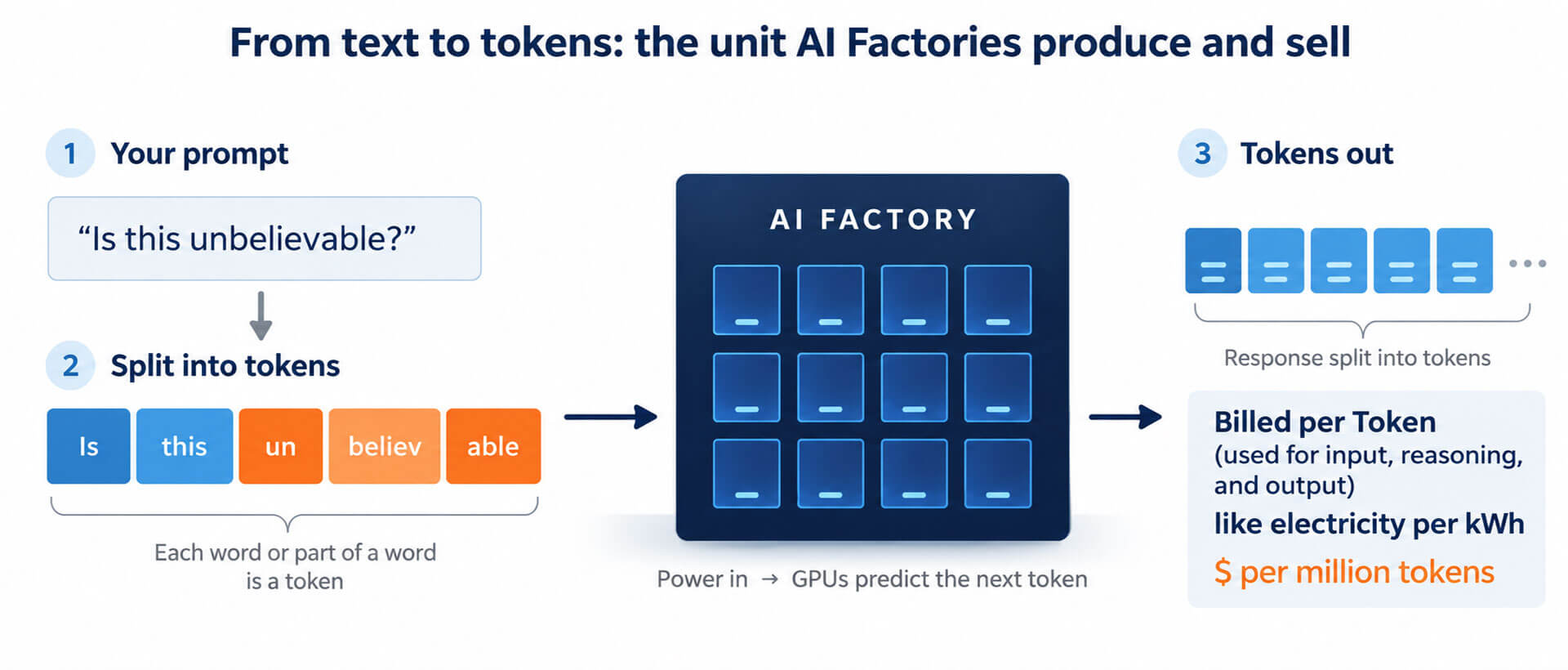
Every prompt, data input, reasoning process, and answer is broken into Tokens, and every Token produced is metered and billed.
The model doesn't read English. It reads sequences of Tokens, converts them into numbers, and runs those numbers through billions of mathematical operations to predict what Token should come next. Then it does it again. And again. String enough of those predictions together, one Token at a time, and you get a coherent paragraph, a working piece of code, or a photorealistic image description.
You don't need to memorize the mechanics. What matters is the concept: Tokens are the foundational unit of AI output. Not words, not sentences, not “responses” — Tokens. Everything an AI model produces, whether it's a chatbot reply, a translated document, or a block of software, is built by stacking Tokens end to end.
Beyond Words: Tokens for Everything
Text is only the beginning. The same idea works for almost any kind of data. An image can be cut into small patches, each one a Token. Audio can be sliced into fragments of sound, video into frames, software into chunks of code. Today's frontier models, the largest and most capable AI systems at the cutting edge, increasingly read and write all of these at once.
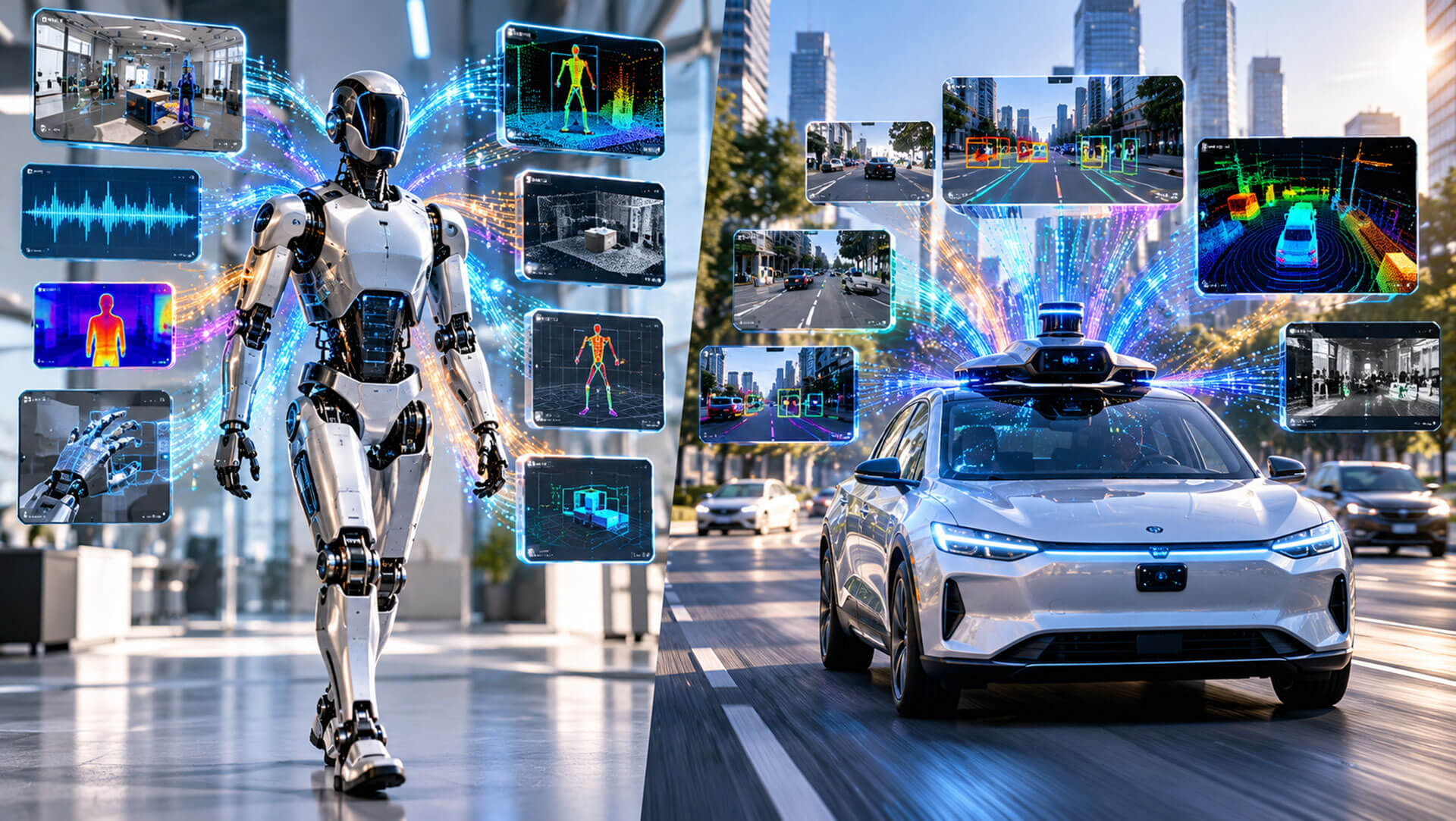
Now the really mind-bending part. The next wave of AI isn't just about answering questions. It's about understanding and acting in the physical world. World models learn how reality behaves — how objects move, fall, collide and interact — by digesting enormous amounts of video and sensor data, all of it converted into Tokens. Physical AI puts that understanding to work in robots, self-driving cars and automated factories.
A self-driving car or a humanoid robot never stops. Every fraction of a second, it takes in streams of data from cameras, radar and motion sensors, turns them into Tokens, predicts what happens next and decides how to move. It's producing Tokens every moment it's ‘awake’. Multiply that by millions of robots and vehicles, and global demand for Tokens stops looking like a big number and starts looking like a new kind of utility, as fundamental as electricity itself.
Some of the most Token-hungry work of all is also the most hopeful: scientific research. To an AI model, the language of life can be read like any other language, with DNA, proteins and molecules all turned into Tokens. One genomics model, Evo 2, built by the Arc Institute with NVIDIA and Stanford, learned from more than 9.3 trillion letters of DNA drawn from around 128,000 genomes, from bacteria to plants to people, and can help pinpoint the genetic mutations that cause disease.[1] Google DeepMind’s AlphaFold, whose creators shared the 2024 Nobel Prize in Chemistry, has predicted the shapes of around 200 million proteins, work that could once take scientists years for a single protein.[2]
Researchers are now using AI to screen vast libraries of potential drug molecules, read medical scans and design entirely new proteins, searching for better treatments for cancer, diabetes and diseases that have resisted medicine for decades. Every one of those experiments runs on Tokens, and lots of them. It’s a reminder that the data centers powering AI aren’t just producing chatbot replies. They may be producing the breakthroughs that change, and save, lives.
More Tokens Than Meets the Eye
When you ask an AI a question, you see two things: your question and its answer. Behind the scenes, there are three kinds of Tokens at work.
Input Tokens are everything the model reads: your question, plus any document, image, conversation history or instructions it needs to review to answer it. Ask it to summarize a 50-page report, and all 50 pages count.
Reasoning Tokens are the model's thinking. Modern reasoning models work through a problem before answering: breaking it into steps, considering possible answers, checking their work and discarding dead ends. You usually never see this thinking, but every word of it is generated as Tokens, and for a hard question it can run many times longer than the final answer.
Output Tokens are the answer itself, the only part you actually read.
In other words, the answer on your screen is just the tip of the iceberg. Most of the work, and most of the Tokens, sit below the surface.
Agentic AI: When One Question Becomes Hundreds of Steps
The iceberg gets much bigger with agentic AI. An AI agent doesn't just answer a question; it gets a job done. It plans a task, uses tools such as web search, maps, calendars and booking sites, checks the results, and keeps going until it's finished.
Take a simple-sounding request: “Find me a good Italian restaurant near my hotel for Friday at 7pm, somewhere quiet enough for a business dinner.” To answer it properly, an agent might:
- Work out what you're really asking for and plan its approach.
- Look up your hotel's location and search a maps service for Italian restaurants within easy reach.
- Read back details on 20 or 30 candidates, including menus, prices and locations.
- Scan hundreds of reviews for clues about the food, the service and, crucially, the noise level.
- Check what it knows about you: maybe you're vegetarian, or you'd rather avoid chain restaurants.
- Check opening hours and table availability for Friday at 7pm.
- Weigh up the options, write you a recommendation and perhaps even make the booking.
Every one of those steps burns Tokens: input Tokens to read each search result and review, reasoning Tokens to decide what to do next, and output Tokens to instruct the next tool. A simple chatbot reply might use a few hundred Tokens. An agent doing the job properly can easily use tens of thousands — for what looks, from your side, like one short question and one short answer.
This isn't hypothetical. Coding agents alone can consume 10 to 50 times more Tokens than a standard chat, as they build up context and search for information.[3] And the number of agents is exploding: research firm IDC expects active AI agents worldwide to grow from about 29 million in 2025 to more than 2.2 billion by 2030.[4] Now imagine billions of agents running errands, writing software, managing supply chains and answering customers around the clock. No wonder demand for Tokens is growing at such a staggering pace.
Why Tokens Matter More Than You'd Think
Here's where it gets interesting from a business perspective. Tokens aren't just a technical detail buried in how AI models work — they've become the literal unit of commerce for the entire AI industry.
When a company uses an AI model through an API — the way most businesses actually access AI, rather than typing into a chat window — they are billed by the Token. Every Token the model reads in from your input, every Token used to reason, research and calculate an answer, and every Token it generates as output, has a price attached to it. A customer service AI answering a support ticket, a coding assistant writing a function, a research tool summarizing a report — all of it gets metered and billed in Tokens, the same way electricity gets metered and billed in kilowatt-hours.
This is a major shift. In the earlier era of cloud computing, businesses paid for capacity: a virtual machine running for an hour, whether or not it did anything useful. That model hasn’t gone away: many AI labs and large enterprises still rent GPUs by the hour, especially to train their own models. But for most businesses using AI, the shift is toward paying for output. You pay for the thing that was actually produced. Tokens are that thing. (Renting GPUs versus paying per Token, and what each means for the economics of AI, is a story we’ll dig into in Blog 4.)
That's why the phrase “currency of AI” isn't just a catchy turn of phrase. A currency is a standardized unit that represents value and can be exchanged. Tokens fit that definition almost perfectly within the AI economy: they are standardized (every provider counts them, even if the exact tokenization differs slightly), they represent value (they are literally what the customer is paying for), and they are exchanged (companies buy compute capacity specifically to produce and sell Tokens).
A Quick Illustration
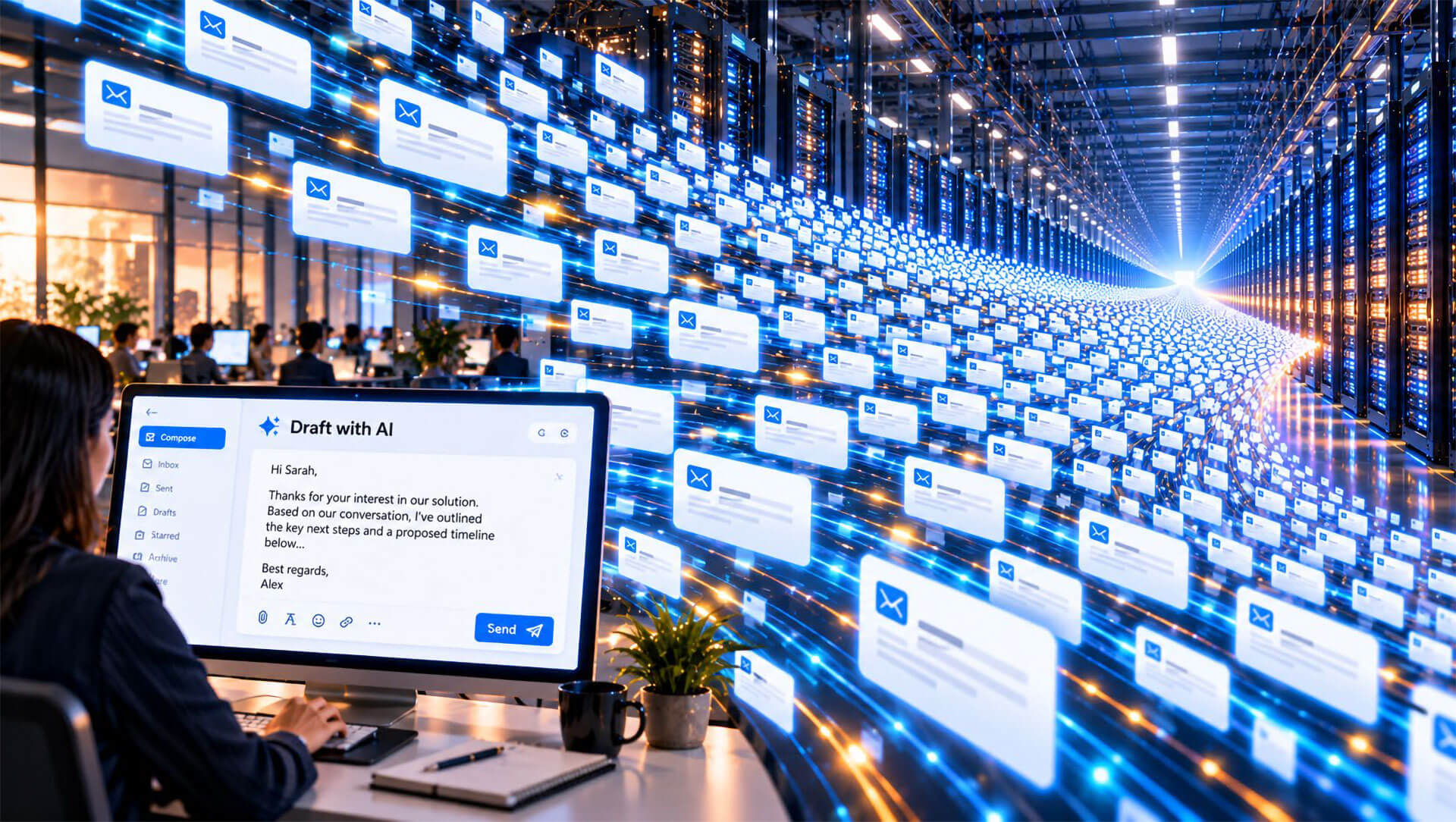
Say a mid-sized company deploys an AI assistant to help draft customer emails. Every email drafted might consume a few hundred Tokens of input (the prompt, the context, any reference documents) and produce a few hundred Tokens of output (the drafted email itself), plus any reasoning Tokens the model uses along the way. Multiply that by thousands of emails a day, and you can see how Token counts add up into real, trackable costs — costs that show up on an invoice with the same specificity as a phone bill itemizing minutes and texts.
Now scale that up, and the numbers get hard to comprehend. In May 2024, Google processed 9.7 trillion Tokens a month across its products. A year later, it was 480 trillion. By May 2026, it had passed 3.2 quadrillion Tokens a month, an increase of more than 300 times in just two years.[5] A quadrillion is a thousand trillion. Spread across a month, that's over a billion Tokens every second, from a single company. And it’s still climbing: up sevenfold in the past year alone.[5]
The story is the same everywhere. China's National Data Administration reports that the country's daily Token use grew from 100 billion in early 2024 to more than 140 trillion by March 2026, a thousandfold jump in two years.[3] Researchers at China Telecom expect China alone to consume 100 quadrillion Tokens in 2026, and more than 35 quintillion a year by 2030.[4] A quintillion is a million trillion: a 1 followed by 18 zeros.
Where Are All These Tokens Made?
Numbers like these change the conversation. When Tokens are produced by the quadrillion, even a tiny difference in what it costs to make each one adds up to enormous sums. That raises the obvious next question: where are all these Tokens actually made, and what decides how efficiently they're produced?
In our next blog, we'll step inside the AI Factory, the new kind of industrial facility built to manufacture Tokens, and meet the metric that's fast becoming the most important number in AI infrastructure: Tokens per Watt.
For now, the takeaway is simple: Tokens are what AI produces and what customers pay for, and they're being produced at a scale that's hard to comprehend. Understanding Tokens is the first step to understanding everything else about how the AI economy actually works.
Sources
[1] Arc Institute, “AI can now model and design the genetic code for all domains of life with Evo 2,” February 2025. https://arcinstitute.org/news/evo2
[2] The Royal Swedish Academy of Sciences, “The Nobel Prize in Chemistry 2024” press release, October 9, 2024. https://www.nobelprize.org/prizes/chemistry/2024/press-release/
[3] CGTN, “China builds computing network as AI token usage skyrockets,” June 18, 2026 (citing China’s National Data Administration). https://news.cgtn.com/news/2026-06-18/China-builds-computing-network-as-AI-token-usage-skyrockets-1O4tgBLAnxS/share_amp.html
[4] CGTN, “Report: China’s token consumption to reach 100 quadrillion in 2026,” September 13, 2026 (citing the China Telecom Research Institute and IDC). https://news.cgtn.com/news/2026-09-13/Report-China-s-token-consumption-to-reach-100-quadrillion-in-2026-1QoRwSLhAhG/share_amp.html
[5] Sundar Pichai, “I/O 2026: Welcome to the agentic Gemini era,” Google, May 19, 2026. https://blog.google/innovation-and-ai/sundar-pichai-io-2026/
